Blog header image

Blog header image

Wednesday, 27 January 2016

Sunday 24 January

Puno – Lake Titicaca – Lima

It was another early rise today so that we could get the boat to visit the floating islands of Uros on Lake Titicaca. 
Panoramic view of Lake Titicaca from our hotel (floating islands off to the left)

Uros is an absolutely amazing place. Our guide went to great lengths to say that this was real, and not just a show. Lesley remembers reading in National Geographic about it when she was young, some 50 or more years ago, so believed that it was real, and was looking forward to visiting it.


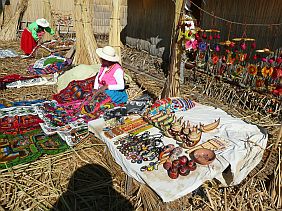
The Uros people have been living there for around 500 years. Today there are 87 islands, give or take a few as they only last about 30 years. The people collect the roots of the reeds and bind them together, using timber to help stabilise them. They then put layer upon layer of reeds on top, first one way then another, to get the surface on which to then build houses. Each island is built and occupied by a family group. Everything is built from reeds, with timber being used now as frames for housing and other buildings. They now have solar power for electricity (novel for islands floating on water). 


The island we visited hosts the junior school and museum, which we visited. In the school was a poster showing everyday items with their name underneath – one was ‘cheque’!! Important, obviously!!


We were given a demonstration of how the islands are built, then anchored so they stay put, then went with various family members to see their houses. 


We were dressed up in their clothing, to see how they lived. Then we had the opportunity to purchase items they had made. Lesley bought two cushion covers. We’d have loved to buy a reed boat, but knew we wouldn’t either get it home in one piece, or be allowed to bring it into Australia.


There is solar power on the islands now, with each house having a panel attached to battery. Seems incongruous to have electricity on islands that just float. 


Sanitation on the islands is as you might expect perhaps (but not think actually possible because it might gross you out!). Each island has separate areas for toileting, washing, and collecting drinking water – BUT ultimately it all happens in the same waters of the lake! We would die if we drank the water, but the people have developed cast-iron guts over the years! The depth of water was about 20m where we were.

We were taken on a ride on one of the reed boats – amazing constructions with two pontoons on which is built a cabin. Nowadays they seem to be using plastic as well as reeds to make them last longer, and are making great use of plastic drink bottles to form pontoons, covered then in reeds. [The ladies lined up on the edge of the island and with huge grins on their faces sang “Row, Row, Row Your Boat’ as the owners rowed us out away from the island!] The reed boat took us to another island where the post office is. Here our passports were stamped with the official stamp used by the people (we had this done in Galapagos and Machu Picchu too).


child's swing

Our guide says that he gives the race another 30 years or so before the govt will have to pay people to live there as a showpiece. The young do not want to stay there – they go to Puno for high school, and want to stay in town. Another set of traditions may be lost.

We then went by coach to the airport at Juliaca. Juliaca by road looks cleaner and nicer than it did by train yesterday, but it is still not a pretty city!

More on construction in Peru – many buildings use a thin galvanised roofing material, which is very shiny so it is glary to look at. Rooves are frequently not nailed down, but rather any manner of other material is used to hold the gal in place – tyres, rocks, pieces of wood, and so on. This adds to the very unfinished nature of the towns.

We flew to Lima over lunch. In the plane we saw animated characters in the safety video. It was odd that they didn’t use real people! We have seen this before, with a different airline. [Saw on ninemsn that QANTAS has a new safety video that uses everyday Aussies in their own space in various parts of Australia, so perhaps it is not so odd after all! Really like the new QANTAS one though!]

Booking in today was a hassle – two flights leaving close together and people lining up for miles for the three only check-in counters. One family held us up because they were on the flight before ours and got there too late to make it! Much consternation and upset! In the end they had to buy more tickets for a later flight, but that cut down the counters to two! They don’t provide headsets in the plane, so showed a video of the 15th anniversary Gags - a candid-camera type of thing. No headsets needed and no language barrier: everyone is laughing! 


First thing we noticed in Lima was the height and number of security fences! Indicative of a social problem, which is a shame. Many buildings, and some streets, had security guards on them to vet who came in and out.


Saturday 23 January

Andes Explorer – train journey to Puno and Lake Titicaca

Stuart got a bad headache during the night, and had the doctor see him. My diagnosis was dehydration, as we hadn’t eaten much yesterday and Stuart didn’t drink much water (a MUST at this altitude), then he had two beers at the cocktail party. Anyway the doctor said it was attitude sickness – his blood pressure was high also - and prescribed electrolytes (a BIG bottle) and four tablets every 12 hours, as well as 500mg of aspirin. Almost no one in the group had aspirin so one lady gave us 5 of her 100mg tablets. The fact that he didn’t drink much of the electrolytes indicates he wasn’t seriously ill.

Today was the 80th birthday of one of our group. He is as fit as a fiddle, however, and you wouldn’t guess. We sang ‘Happy Birthday’ and he cut a tiny cake at the hotel.

Our journey today was via the Andes Explorer, a very comfortable train that is one of the must-do train journeys of the world. It is a 10hr trip from Cusco to Puno.


These were our seats for the journey
We travelled through some lovely countryside. The train travelled beside the Vilcanota (Urubamba) River, going in the opposite direction to the river this time. We gradually climbed until we reached the highest point at La Raya. Here the train stopped for 10 minutes so we could take photos of the church, and the sign declaring the altitude (4319m) and look at the wares of the locals who were all set up to sell to us.


Who needs roofing nails?


Some locals (Lesley had to pay for taking the photo)

The scenery for the second half of the journey was a large flat plain that went forever. It was surrounded by mountains in the distance. Locals dotted here and there eek out a living with livestock – cattle, sheep and llamas. The plain had no trees, but small crops were growing nicely to feed the livestock and locals. They are currently experiencing a drought (El Nino) and worry about the farmers too, as in Australia.


Peru is not a clean country. Dust pervades everything, due to dirt roads and low rainfall, and rubbish is strewn everywhere. There doesn’t seem to be a sense of pride in the appearance of the country. Also memorable for Lesley (for all the wrong reasons perhaps) are the unfinished buildings everywhere you look. The locals live in them like this – certainly a different way of life to us!


We were treated to a cultural show of music and dancing (as much as was possible on a train). The male dancer got Lesley up and they danced down the corridor. He led well and she was able to do as he wanted for most of the time. She was quite puffed at the end though! Good fun! The musicians also played ‘Happy Birthday’ for David!


There are no level crossings as we know them, so the train has to blast on the horn – LOTS! Drivers stop if they value their lives. In Cusco Lesley could see out the window on a bend and the four lanes of traffic crossing the rail track showed no sign of stopping until the train was REALLY close, and blaring its horn loudly!

In one of the bigger towns (Sicuani) the train went through a large market – the train so close that we could have reached out and touched the stalls and taken an item! Amazing! 


This happened again at Juliaca (pronounced ‘Hule-ee-ar-ca). This town is the capital of fake, we were told – all fake souvenirs sold in the cheap markets in Peru are made here! Seen from the train it was a dirty town – mostly dirt roads, and of course the inevitable rubbish all around, and unfinished buildings.


Sunday, 24 January 2016

Friday 22 January

Cusco

Free day for us, so we started by going to an animal refuge to see condors and pumas for the morning. This is like any animal refuge, where injured or smuggled animals go. We saw the pumas, who had been drugged in a disco so patrons could pat them, or macaws which had been kept in tiny cages and had broken wings or damaged tails (which don’t grow back). Llamas, alpacas, deer, tortoises, monkeys of various sorts – all needed rescuing from bad situations. The condors are monogamous, and have only one egg every four years, so they are trying to get a pair to release back into the wild. There are only 400 condors left in the wild in Peru.


Lesley making friends with an albino (blue eyed) llama
Puma
Iconic view of  condor spreading his wings


macaws that can't be released due to ill-treatment before being rescued
alpaca wool coloured with natural dyes
12 year old girl weaving - she's been doing it since was seven
We then waked around the city a bit, looking at two museums which were included in our entry to a historic site we had already visited and saw all manner of things. The Incas actually had models of the buildings and sites they constructed – we saw one such model on a rock. They also mummified their dead loved ones (with knees up to chin and posing with hand on face etc), then carted them around with them! If the person visited another person in life, then they were taken visiting after death. Mummies were placed together if they were friends before they died. A very considerate culture! We also saw skulls with holes in them, not by being bashed with a rock, but by being deliberately operated on to correct an ailment. One of the holes was square!

We decided to pay the cost of sending some purchases back home, so as not to have to carry them with us. We are keeping the jumpers, and pashmina Lesley bought, as they will be useful later.


rock showing stairs and walls - Incan model for a building
Tonight we had a cocktail party with some nibblies and musicians. A free night, so some went out to dinner. We stayed at the hotel and had soup and bread with another couple – that’s all we wanted. Been eating too much. Lesley bought an alpaca pashmina. She had a lighter one bought on the Gold Coast but wanted one that would be a little warmer. Very nice!

Leaving early tomorrow for Lake Titicaca, going by train through the Andes. This apparently is one of the world’s best train journeys. Ten hours in all. Looking forward to it.